
There’s a feeling you get when an idea you worked on years ago resurfaces in someone else’s campaign. Not quite pride, not quite frustration. Something more like there it is. That was my reaction when someone shared the recent ‘It takes a little Westpac’ work with me. The “quiet enabler” framing is good. Honest, human, and it positions the bank as something other than a product vending machine. But my first thought wasn’t nice. It was we were saying exactly this sixteen years ago.
Back in 2008, a group of us at ANZ were sitting in meeting rooms late into the evening trying to articulate the idea that a bank’s job wasn’t just to hold money or lend it, but to actually help people do better with what they had. Initiatives like Be Money Confident came from that instinct. So did the A–Z Review, which was an attempt to give customers a complete picture of their financial life and support meaningful action towards their goals. We weren’t alone. This was around the same time as NAB’s more than money matters, for instance. But we had little more than campaigns, and programs, and the occasional product feature bolted on to carry the message. Not because we didn’t have the vision, but because the infrastructure at the time couldn’t enable it.
The architecture underneath our ambitions was product-centric by design, built over decades to serve accounts and transactions rather than people and journeys. Enabling financial progress in that environment meant layering intention on top of a system that wasn’t well shaped to deliver it. The campaigns were sincere but inevitably the customer experience of “we want to help you get ahead” arrived as a brochure, a seminar, or a one-size-fits-all savings message in a monthly statement. It looked like philosophy, and honestly I suppose it was because that’s about as far as the plumbing would reach at the time.
That’s why I see what’s happening now is not a new idea tapping into a moment, but an old idea finally finding its infrastructure.
Before getting into what that infrastructure makes possible, it’s worth being aware of how varied the answer to “what do customers want from banks” actually is. Generation, culture, financial confidence, life stage – these all shape what meaningful engagement looks like. A twenty six year old who grew up with Duolingo feels differently about a savings nudge to a fifty year old who finds the same mechanic vaguely insulting. While we’re seeing gamification-as-entertainment landing genuinely well in some markets that’s not the case everywhere. For instance, in Australia, New Zealand, and the UK, my instinct and the data both point toward something quieter, where the opportunity is less about fun and more about intelligent invisibility that reduces decision fatigue and enables the right habits.
And yet there are a handful of things that seem to hold. Nobody wants to be lectured. Nobody wants to lose ground because of a single bad month. And almost everyone responds positively to the feeling that their finances are actually moving in the right direction, that the system is working with them rather than waiting for them to slip.
That last point is where legacy mechanics so often fail the people they’re meant to serve. Take the classic savings bonus as an example: miss one month and the benefit is lost. The customer who missed in February, say because of a car repair or a drop in pay loses the reward they’d been building toward. The message that sends is that the offer was for people who don’t need help. The customers who most need the momentum are precisely the ones most likely to be penalised by these kind of cliff-edge mechanics. And the fact is that this isn’t a philosophy problem. It’s an infrastructure problem. A system that can’t distinguish a genuine slip from a chronic pattern will always default to binary outcomes. And some banks are already drawing the right conclusion, dropping the hoops and catches and letting customers earn without the conditions.
Real-time engagement now means you can ingest behavioural signals as they happen, not after month-end. Spend patterns, app logins, savings timing, card primacy – the small signals that indicate whether someone is engaged or drifting. Hyper-personalisation, done well, means the intervention matches the moment rather than arriving two weeks late in a generic email. Journey orchestration means you can develop a continuous understanding of a customer’s financial arc and respond to it intelligently, rather than treating each interaction as an isolated transaction.
Additionally, alternative reward funding models are changing something more fundamental than the commercial equation. By moving away from margin-funded features toward engagement economics, banks can finally afford to respond to customers as people rather than patterns, extending grace when someone slips, recalibrating rather than penalising, and doing it consistently across millions of customers rather than as an exception a branch manager makes for a good customer they happen to know personally.
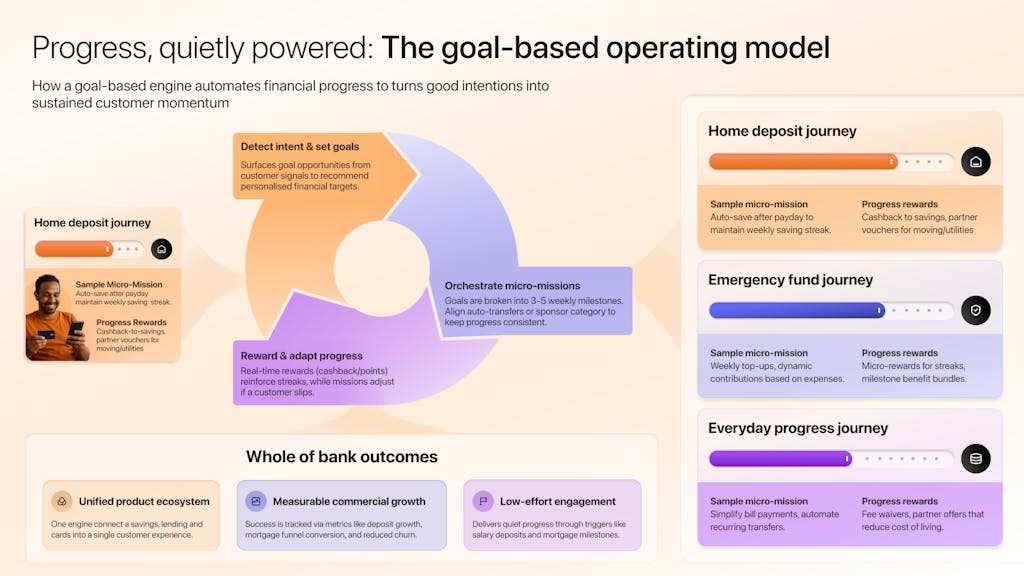
What this makes possible, concretely, is goal-based engagement that operates across the whole bank rather than within a single product. Imagine a customer whose signals suggest they’re saving toward a home deposit. They could get a personalised track, not a brochure. The abstract ambition, “I want to buy a place in five years,” would be broken into achievable micro-missions: auto-save after payday, fee waivers, a reward nudge calibrated to their actual spending habits, and a mortgage-readiness prompt when the numbers start to make sense. Progress can be rewarded adaptively, with cashback flowing into their goal account, celebrations at milestones, and partner offers arriving when they’re relevant rather than random. The customer has a hard month? The system recalibrates rather than penalises. The timeline adjusts, and momentum is preserved.
The commercial case is there: Deposit growth, mortgage funnel conversion, and reduced churn. These aren’t soft engagement metrics, they’re primary relationship outcomes, and they follow naturally when customers feel their bank is genuinely oriented around their progress rather than its own marketing calendar.
It’s that shift from campaign to operating model that matters. A campaign says “we believe in enabling financial progress” for twelve weeks. This operating model actually does it, invisibly, continuously, personalised to the individual, and with the commercial discipline to sustain it.
What that operating model looks like is going to be up to each bank. The vision, the values, the brand promise, none of that originates with us. What Pulse provides is the mechanics that make a bank’s existing vision executable. The engagement infrastructure, the signal ingestion, the orchestration layer, the reward logic that can bend without breaking when a customer has a hard month. Every institution determines its own north star. We help wire it.
The diagram below shows the engine underneath this kind of experience: one that can detect intent, orchestrate micro-missions, and reward and adapt in real time. Three loops for an always-on experience rather than a campaign that runs and stops.
I spent years inside banks trying to move these ideas forward and running into the limits of what the systems could do, the gap between what we wanted to offer customers and what the architecture would actually deliver. That gap is what makes working on this side of it feel like something worth doing.
When I saw that Westpac campaign, what I felt was something close to relief – not because a large bank had validated the insight, but because I can see the gap between ambition and infrastructure is finally closing. The things we were sketching on whiteboards in 2008 are now buildable. The philosophy hasn’t changed, the feasibility has. It’s not a new idea, but an old one that’s finally got somewhere to land.
